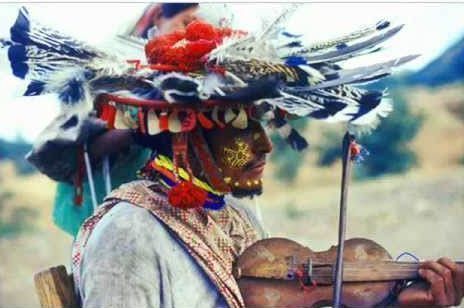
Traditional Huichol music
Traditional Huichol Music. Huichol music is one more way of reflecting that spirituality, which is also linked to each festival, having its own music, music for the ceremonies, for the sacrifices, for the dance.
With very few instruments, only the violin, the guitar, the tepo (drum, the voice of God for the Huichol) and the sonaja (rattle made from a gourd), apart from the flute and the horn, used sporadically, these are the means by which the Huichol musician communicates or expresses his experiences.
Being an almost pentatonic music, using only a five-tone scale, its listening can seem dizzying, apart from being certainly repetitive.
In Canto y Ceremonial Huichol, the Cruz family offers 9 Huichol songs, some of them recorded under cover of fire.
Contemporary Huichol music
Huichol music is very varied. Among the traditional genres are the xaweri and kanari (rabel and guitarrita) songs, which are always sung with new improvised verses and played with native instruments to accompany the zapateada dance.
The repertoire of the mariacheros includes corridos and other popular songs, whose lyrics are sometimes in Huichol, but are played with instruments of mestizo tradition (violin, vihuela, contrabass). Currently, the most famous ensemble is the Venado Azul from Nueva Colonia, Jalisco.
The mountains of the Sierra Madre Occidental, north of Jalisco, are inhabited by a mystical and beautiful culture in which enigmatic worlds are constantly created whose recurring protagonists are moons, suns, trees, labyrinths, spirals, mountains and cosmic oceans that tirelessly appear expressed in the art, religion and customs of the Huicholes.
One of the best known groups of Wixarika music is "Huichol Musical" They were formed as a group in Fresnillo, Zacatecas but most of the members of the original group are from Nueva Colonia, municipality Mezquitic, state of Jalisco, Mexico.
Another group is "El Venado Azul" The group El Venado Azul was formed by four members of the Huichol community of the northern highlands of Jalisco. After the disintegration of the original group, José López Robles, founder and director of the group decided to relaunch the concept, maintaining the original roots of their region, i.e. the Huichol dialect and the characteristic dress.