
Jicara people and arrow people
21/06/2024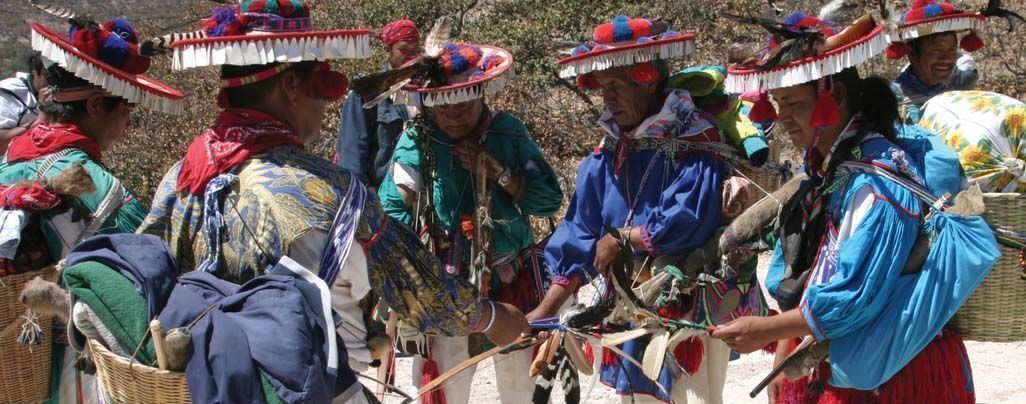
Jicara people and arrow people
Research on the Wixaritari initially focused on issues of community organization and ritual. It emphasized the interrelationship between the symbolic and the social. As has happened in other research on Amerindian peoples, it was initially impossible to separate the different spheres. And soon I discovered the inevitable: that among the Huichol there is no notion of the immaterial, their entire culture is material.
The objects involved in their lives can be studied by their relationships, there is a close link between some of them and certain persons, who identify themselves with particular objects, while these objects are conceived among the Huichol as persons. In the Wixarika world, there are jicara-persons and arrow-persons. What do these denominations refer to? One is born jícara (xukuri, plural xucurite), or from a jícara, and eventually one ends up being born and becomes an arrow (iri, plural irite). Thinking about these identifications is a challenge, because the relationship between jícaras and arrows is complicated, and it is not just a progression. Being an arrow or a jicara implies different ways of seeing the world and the environment.
Because of their complexity and dynamism, the documentation of Huichol rituals is a challenge and one easily gets lost in the details. To study them it is necessary to focus on the most recurrent elements of the ceremonies or on ritual sequences, relatively fixed, that appear in diverse contexts, although always in different combinations, one of the constellations that emerge from the apparent ethnographic material chaos is the so-called offering of arrows and jicaras that, according to Daniele Dehouve (2007) should be called ritual deposit, without a doubt a more adequate term for this group.
The Huichol world is divided into three universes: the world of the mythologythe Huichol holds that life began in the ocean; the Huichol refers to the corn, where daily life and Huichol traditions are developed and the one that has to do with the mysticism, which reveals the Huichol world and the Huichol art of their rituals that distinguish them and give them identity as a Huichol community.
Until a few decades ago the collection of the pieces was a relatively simple task, because once deposited, the votive objects lost their ritual significance for their donors. It was thus that ethnographers such as Carl S. Lumholz (1851 - 1921) and Konrad Tehodore Preus (1869 - 1938) documented them from the samples they collected in situ. Today this is no longer so easy. Harassed by tourism, the Huicholes no longer tolerate anthropologists and collections appropriating the offerings. However, the subject continues to be one of the least complicated for ethnography. And the fact is that, accustomed to give explanations to the buyers of handicrafts, many Huicholes have no problem in revealing certain meanings of their pieces, besides, during the second half of the XX century they developed different handicrafts from the recurrent models of the rituals.
Many times anthropologists are invited to participate in the elaboration of votive objects, for delivery to distant sacred sites, visiting friends with motorized vehicles are cordially requested to offer a raite. In this way the knowledge of anthropologists in this field has been acquired in praxis.
The complex ritual related to the offering of arrows and jícaras is a good example to illustrate cultural continuity in the Gran Nayar. Although important aspects of the cult were lost, among them the veneration of mummies or sacrifices, the ritual pieces mentioned in colonial and 19th century sources are very similar to the present ones.
If you wish to purchase pieces of Huichol art please go to Huichol art for sale - Online Store

